Mumbai’s real estate market story has evolved in waves. A look at the city’s urban growth history shows how dominance shifted from South Mumbai with the suburban expansion, followed by the rise of Navi Mumbai and the rise of Thane. With the Maharashtra government announcing the Mumbai 3.0 project, the next chapter of Mumbai’s growth story appears to be unfolding. This time, it will spread across the extended Mumbai Metropolitan Region (MMR).
Even as “Mumbai 3.0” does not yet have a formal industry definition, developers and market experts have used the term to describe Mumbai’s next phase of outward expansion beyond its traditional urban boundaries. Industry observers believe the phenomenon is less about branding and more a structural reaction to the pressures of a saturated urban core, rising property prices, and limited land availability within Mumbai city.
As the challenges of making affordable homes intensify, both homebuyers and investors are beginning to shift their focus. Emerging corridors where infrastructure, accessibility, and future growth potential are converging have particular interest. Stretching across emerging corridors such as Panvel, Karjat, Khalapur, Pen, and Alibaug, Mumbai 3.0 is being shaped by the government vision and a powerful combination of infrastructure investment, affordability, and changing buyer aspirations.
Bhavesh Shah, Joint Managing Director, Today Group, observes that Mumbai 3.0 denotes the structural shift in how the MMR will evolve over the next decade. “Mumbai 3.0 is set to be MMR’s biggest urban transformation in decades. If South Mumbai was the original economic nucleus and Navi Mumbai the first planned expansion, this next phase is creating an entirely new metropolitan framework driven by infrastructure, connectivity, and large-scale urban planning,” he says.
For Bhavesh Shah, what makes this cycle different is that multiple growth corridors are evolving simultaneously, supported by projects such as the Navi Mumbai International Airport, Atal Setu, metro expansion, and multimodal transport networks. “Infrastructure is no longer merely supporting growth — it is actively determining where growth will happen,” he adds.
According to Vishal Ratanghayra, Founder & CEO, Platinum Corp., the concept of Mumbai 3.0 is fundamentally linked to infrastructure-led urban growth. “Historically, Mumbai’s expansion has always followed connectivity and infrastructure development. Today, a similar transition is taking shape across emerging peripheral corridors where accessibility, economic activity, and planned development are steadily converging. Affordability has remained among the strongest demand drivers across Mumbai 3.0. This is particularly seen among younger homebuyers who are increasingly gravitating towards plotted developments and organised land communities. They are placing greater emphasis on creating long-term asset appreciation and future-ready communities instead of viewing ownership purely through the lens of standalone built-up assets,” he says.
Ratanghayra further points out that the emergence of organised plotted communities, integrated townships, and branded land developments will play a defining role in shaping a more decentralised and planned model of growth across the MMR region. “This is still an evolving landscape, but trust is no longer optional in plotted developments. It has effectively become part of the product itself. While many may be selling land, the real differentiation lies in offering clear title, legal confidence, and a thoughtfully designed product capable of delivering superior long-term value.”
Industry experts point out that rising property prices in core Mumbai and parts of Navi Mumbai have pushed both investors and end-users to explore emerging micro-markets that still offer long-term value potential. What differentiates Mumbai 3.0 from earlier expansion cycles, however, is the scale of infrastructure currently underway.
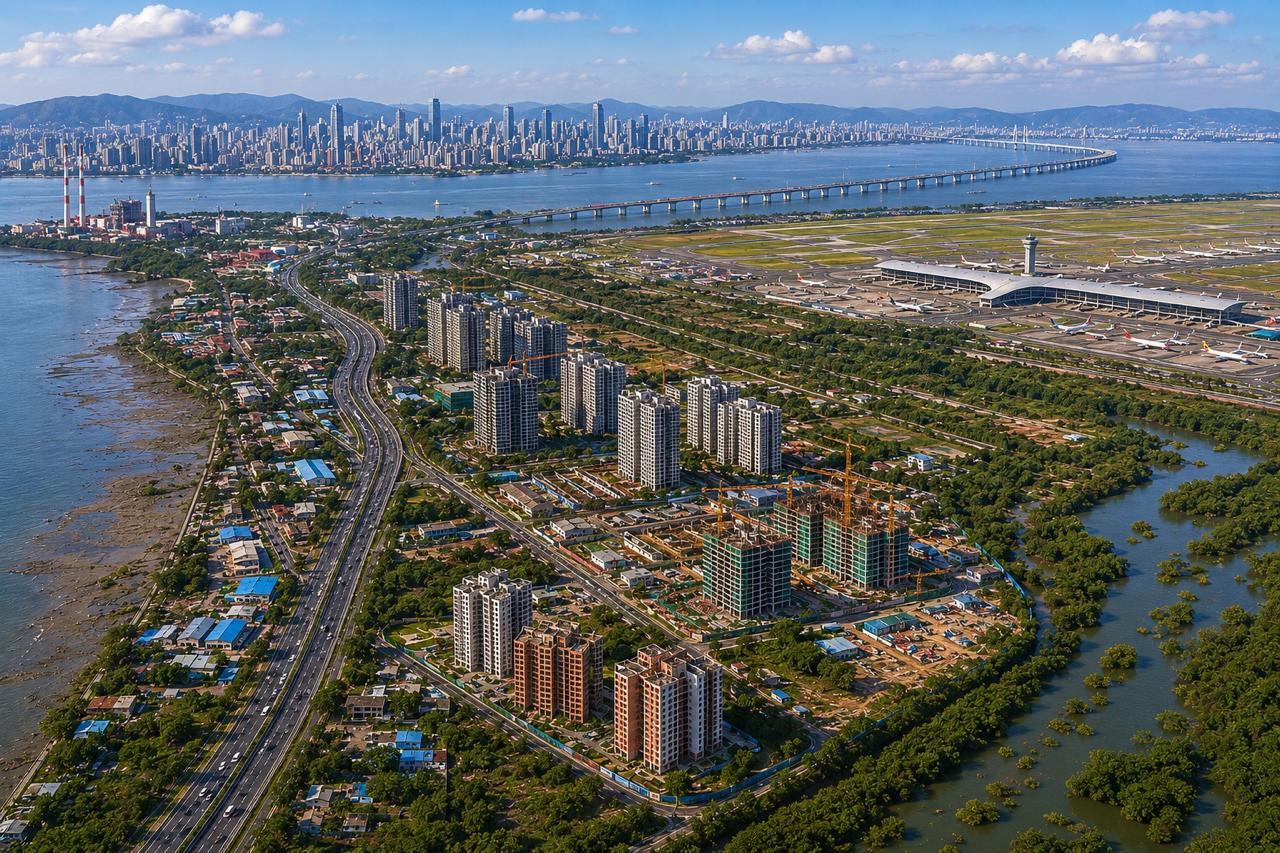
Mega projects such as the Navi Mumbai International Airport, the Mumbai Trans Harbour Link (MTHL), the Virar–Alibaug Corridor, Panvel–Karjat railway expansion, and enhanced connectivity around JNPT are significantly altering travel patterns and perceived distances across the MMR. These developments are not only improving connectivity but also reshaping residential and investment demand.
Porush Jhunjhunwala, CEO of Banke International Properties, sees this infrastructure convergence as fundamentally changing how buyers evaluate real estate opportunities. “We have buyers who are far more comfortable travelling longer distances, provided connectivity is efficient and commute times remain predictable. This evolving mindset is opening up entirely new growth corridors across the MMR region. The government’s concept only furthers this,” he explains.
At the same time, buyer preferences themselves are undergoing a notable transformation. Increasingly, plotted developments are gaining traction over traditional apartment ownership, particularly among younger investors, NRIs, and second-home buyers.
In Bhavesh Shah’s view, this evolution in buyer mindset is one of the defining characteristics of Mumbai 3.0. “We see that the buyers today are far more strategic. This is true for end-users prioritising quality of life and integrated communities, and investors focusing on long-term wealth creation rather than short-term appreciation. The appeal of Mumbai 3.0 lies in the ability to participate early in an infrastructure-led growth story where affordability, accessibility, and future potential are converging. Standing apart from mature markets where pricing has already stabilised, these emerging corridors continue to offer scale, planned development and strong long-term upside, making them increasingly attractive for both residential and investment demand.”
Unlike apartments, plotted developments offer flexibility and phased decision-making. Buyers can purchase land today and choose when and how they wish to build in the future. Industry observers note that this flexibility is becoming increasingly attractive in an environment marked by rising construction costs, evolving work patterns, and growing demand for low-density living.
The plotted development segment is also registering a shift towards the emergence of organised and lifestyle-oriented communities. Developers are increasingly integrating landscaped greens, wellness spaces, clubhouses, sports amenities, co-working infrastructure, and low-density planning principles into projects that were once viewed purely as land parcels. This evolution is seen as a broader change in consumer expectations where buyers are no longer just purchasing land but are investing in future-ready ecosystems designed around lifestyle, wellness, and community living.
Interestingly, the growing interest in plotted developments is also being supported by greater regulatory transparency and digitisation within the sector. Developers are placing stronger demand on clear land titles, structured documentation, and compliance frameworks. This is particularly the case where first-time buyers with far higher awareness levels than before are entering the market.
According to market observers, the appreciation cycle for plotted developments is also different from conventional apartment markets. While apartment values tend to rise gradually, land investments often witness sharper value appreciation once infrastructure projects become operational and surrounding ecosystems mature.
This has encouraged a more patient and strategic class of investors to enter the market. NRIs increasingly view land as a stable long-term asset linked to India’s growth story, while younger buyers are approaching plotted developments as future-oriented investments offering significant upside potential over a five-to-ten-year horizon.
According to Parthh K Mehta, CMD, Paradigm Realty, “the impacts of Mumbai 3.0 are being felt across asset classes. For luxury buyers, it presents the incredible opportunity to invest in plotted developments, which are emerging as a significant asset class.”
He further says that, “this shift is supported by transformative infrastructure projects such as the 21.8-km Atal Setu, the Navi Mumbai International Airport, and new expressway corridors, which are expected to drastically improve regional connectivity. In emerging micro-markets such as Panvel, Karjat, and Khalapur, plotted developments are increasingly attracting both end-users and investors looking for long-term appreciation and land ownership opportunities.
Today, luxury consumers are prioritising space, wellness, and low-density living over conventional apartment-led formats. In Mumbai 3.0 corridors, plotted land developments are priced between ₹3,000 and ₹15,000 per sq. ft, depending on infrastructure proximity, which remains significantly lower than Mumbai’s traditional luxury markets where prices can exceed ₹50,000–₹1 lakh per sq. ft. The current market estimate suggests that well-connected nodes around airports and infrastructure corridors could witness an annual appreciation of nearly 15-25 per cent over the next few years.
We believe this shift reflects a deeper evolution in luxury housing, where buyers are increasingly valuing flexibility, custom-built homes, and integrated plotted communities that combine lifestyle, connectivity, and long-term asset creation.”
Porush Jhunjhunwala believes that Mumbai 3.0 will eventually evolve not as a single, standalone destination, but as a network of interconnected micro-markets functioning as natural extensions of Mumbai’s economic ecosystem. As connectivity improves and decentralised urban development gathers pace, these emerging regions are expected to play a defining role in shaping the future of planned living across the MMR.
Experts believe the future success of Mumbai 3.0 will depend less on physical distance from Mumbai’s traditional business districts and more on the predictability and efficiency of connectivity. As infrastructure networks mature, emerging growth corridors are expected to evolve into interconnected urban clusters offering residential, commercial, and social ecosystems within shorter and more manageable commute patterns.
What is becoming increasingly clear is that Mumbai’s next phase of expansion may no longer revolve around vertical growth within the city core alone. Finally, as the Mumbai 3.0 plans gather pace, plotted developments are emerging as the defining expression of the city’s outward expansion, where infrastructure, affordability, and aspirational living are converging across the wider MMR.